Magneto-optical studies of Strongly Correlated Materials
Published in Stanford University, 2025
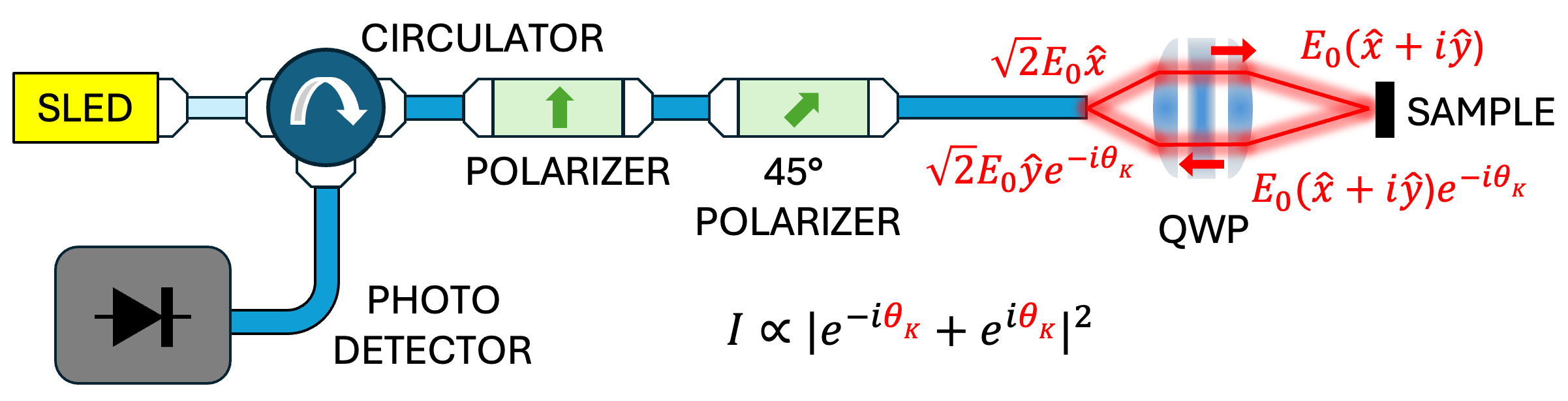
This thesis presents a series of magneto–optical investigations into strongly correlated quantum materials, focusing on the emergence of unconventional orders and their interplay with electronic structure. The magneto–optical Kerr effect (MOKE), implemented via a cryogenic Sagnac interferometer, serves as the primary probe, enabling the detection of time–reversal symmetry-breaking (TRSB) phenomena with state-of-the-art precision.
The first part of the work examines infinite–layer nickelate superconductors, a newly discovered class of high–temperature superconductors closely related to cuprates. We report the observation of a spin–glass state that onsets well above the superconducting transition temperature. This finding provides unambiguous evidence of a disordered magnetic phase embedded within the superconducting state, shedding light on the role of magnetic frustration in nickelates.
The second part addresses the ongoing debate over time–reversal symmetry breaking in the kagome charge–ordered superconductor CsV3Sb5. Using high–sensitivity MOKE at multiple wavelengths, we compile and analyze an extensive dataset obtained over several years. While the collective body of experimental evidence remains contradictory, our measurements enable us to present well–reasoned arguments against the presence of time–reversal symmetry breaking in this material.
By combining high–precision magneto–optical measurements with careful material–specific analysis, this work advances our understanding of how complex electronic orders emerge and coexist in strongly correlated systems. It highlights the unique power of MOKE as a probe of subtle broken symmetries.